Service reliability
Treat every missed pickup as a classified event, not a complaint
A missed pickup is only useful if the team can tell whether it was a customer setout issue, route data issue, driver issue, access issue, or communication issue.
The quick answer
To reduce missed pickups, haulers need accurate route data, proof that service was completed or could not be completed, fast customer communication, and a short recovery loop. The fix is rarely one giant route redesign. It is usually better classification and faster follow-through.
National League of Cities collection guidance makes a simple point that private haulers should take seriously too: reducing misses and go-backs depends on knowing whether service was completed or not completed at the stop level.
Classify every miss before you fix it
| Miss type | What it usually means | Better response |
|---|---|---|
| Customer setout issue | Cart not out, wrong day, overloaded cart, blocked material, or contamination | Send clear customer guidance and capture a non-collection reason |
| Route data issue | Wrong address, wrong service day, bad container count, or missing stop | Correct the account record before the next route is built |
| Route capacity issue | Driver ran out of hours, truck filled early, route was overbuilt, or disposal took too long | Audit route hours, disposal timing, and add-on policy |
| Access or safety issue | Locked gate, blocked alley, unsafe backing condition, weather, or construction | Require proof, notify the customer, and schedule the recovery with context |
| Communication issue | Holiday shift, service change, new customer, or route transition was not understood | Use waste customer portal software and proactive notifications before the service day |
The 24-hour recovery loop
The first 24 hours matter because the customer's memory is fresh, the driver can still explain the route, and dispatch still has the day's context. A strong recovery loop captures the complaint, checks route proof, classifies the cause, schedules the recovery if the hauler owns it, and updates the customer with a specific answer.
Do not let "missed pickup" become a single generic ticket type. That creates a pile of complaints, not an improvement system.
Prevent repeat misses
- Require drivers to choose a non-collection reason when service cannot be completed.
- Attach photos only when they help prove blocked access, contamination, overload, damage, or unsafe conditions.
- Review repeat misses by address, route, driver, and service day.
- Freeze service-day changes earlier when route transitions are causing confusion.
- Separate customer-error misses from hauler-error misses in reporting and customer conversations.
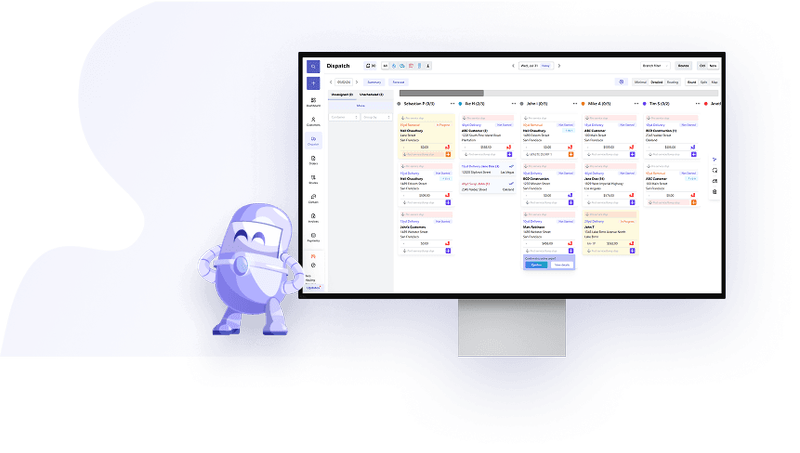
- Use waste dispatch software to keep route changes and recovery work visible on the same board.
What to measure
Track missed pickups per 1,000 stops, recovery time, repeat misses at the same location, non-collection reason usage, and proof capture rate. Then review the top causes each week. If route data is the top cause, do not yell at drivers. Fix the data.
The strongest teams also review how many misses became credits, refunds, go-backs, or disputed invoices. That connects customer service pain to real operating cost.
Frequently asked questions
How do waste haulers reduce missed pickups?
Reduce missed pickups by keeping route data current, giving drivers simple exception categories, capturing proof of service or non-service, reviewing repeat locations, and closing customer communication quickly.
What causes most missed trash pickups?
Common causes include inaccurate route data, customer setout issues, blocked access, overloaded routes, holiday schedule confusion, disposal delays, and weak driver-to-dispatch communication.
Should every missed pickup require a photo?
No. Photos are most useful when they prove blocked access, contamination, overload, unsafe conditions, or service completion. A structured reason code is often faster and cleaner for routine exceptions.
What to do next
Pair the proof of service workflow with waste management driver app, waste dispatch software, and waste customer portal software. For route-level fixes, read the route audit playbook and run the route profitability calculator.