
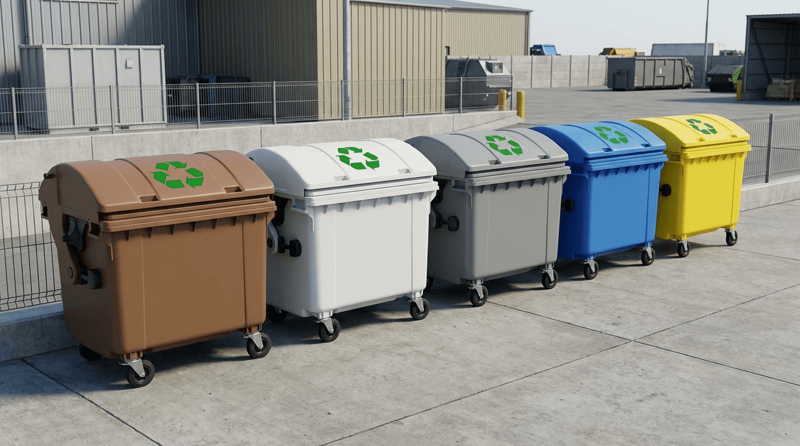
1. Americans generate nearly 5 pounds of trash per person every day
The average American produces about 4.9 pounds of municipal solid waste (MSW) per day—roughly 1,800 pounds per year. That adds up to nearly 300 million tons of waste annually across the United States. Despite recycling efforts, the per-capita waste generation has increased over the past decades, driven by packaging, single-use products, and consumer habits.
2. Only about 32% of waste gets recycled
According to the EPA, the U.S. recycling rate for municipal solid waste hovers around 32%. The rest goes to landfills (about 50%) or is combusted for energy recovery (about 12%). Countries like Germany and South Korea achieve recycling rates above 50%, showing significant room for improvement in American waste management practices.
3. The waste management industry employs over 500,000 workers
Waste collection, recycling, and disposal support hundreds of thousands of jobs across the country. Drivers, sorters, facility operators, and administrative staff keep the system running. See our waste management salary guide for pay benchmarks by role.
4. Landfills are the third-largest source of human-related methane
When organic waste decomposes in landfills without oxygen, it produces methane—a greenhouse gas roughly 25 times more potent than carbon dioxide over 100 years. Landfills account for about 15% of U.S. methane emissions, making improved diversion and composting critical for climate goals.
5. Plastic recycling rates are surprisingly low
Less than 10% of plastic waste in the U.S. is recycled. Contamination, mixed plastics, and limited markets for recycled resin contribute to the low rate. Many plastics end up in landfills or incinerators, highlighting the need for source reduction and better design for recyclability.
6. Food waste accounts for 24% of landfill content
Food is the single largest category of material in American landfills by weight. Households, restaurants, and grocery stores discard billions of pounds of edible food annually. Composting and food rescue programs can divert much of this waste while reducing methane emissions.
7. The u.s. Waste industry is worth over $80 billion
The waste management and remediation services sector generates more than $80 billion in revenue annually. Private haulers, municipal programs, and recycling facilities form a complex ecosystem. Check our industry statistics page for market size and growth data.
8. Paper and cardboard are the most recycled materials
Paper and cardboard have the highest recycling rates among common materials—around 68% for paper and 89% for corrugated cardboard. Strong markets, established collection systems, and clear end uses make these materials the success story of American recycling.
9. Single-stream recycling increases participation but can lower quality
When households put all recyclables in one bin, participation rises, but contamination often increases. Mixed materials can reduce the value of recovered commodities. Some communities are moving to dual-stream or source-separated systems to improve quality.
10. Waste-to-energy plants generate electricity for millions of homes
Combustion facilities that burn non-recyclable waste produce steam and electricity. There are roughly 75 waste-to-energy plants in the U.S., generating enough power for about 2.3 million homes. The process reduces landfill volume and recovers energy, though it remains controversial among environmental advocates.
11. Construction and demolition debris exceeds municipal solid waste
Construction and demolition (C&D) waste—concrete, wood, metals, drywall—exceeds the volume of household trash in many regions. Much of it can be recycled or reused. Haulers and contractors use commercial waste estimate templates to quote C&D disposal jobs.
12. E-waste is the fastest-growing waste stream
Electronic waste—computers, phones, TVs—grows faster than any other category. Only about 15% of e-waste is recycled globally. Proper recycling recovers valuable metals and prevents hazardous materials from entering landfills.
13. Haulers rely heavily on route optimization
Inefficient routes burn fuel and driver time. Software that optimizes stop sequences can save 5+ gallons of fuel per truck per day. Use our ROI calculator to estimate savings from route optimization.
14. Extended producer responsibility (EPR) is gaining traction
EPR laws require producers to fund or manage the end-of-life of their products. Several states have passed EPR for packaging, shifting responsibility from municipalities to brands. This trend may reshape recycling economics.
15. Hazardous waste requires special handling
Batteries, paint, chemicals, and certain electronics are classified as hazardous and cannot go in regular trash. Improper disposal risks fines and environmental damage. Haulers and facilities must follow strict regulations.
16. The average landfill receives waste for 30–50 years
Modern landfills are engineered facilities with liners, leachate collection, and gas capture systems. They typically operate for decades before closure and post-closure monitoring. Space for new landfills is increasingly scarce in many regions.
17. Recycling creates more jobs than landfilling
Recycling and reuse create roughly 10 times more jobs per ton of material than landfilling or incineration. Sorting, processing, and remanufacturing employ more people than disposal.
18. Commercial waste often costs more than residential
Businesses typically pay higher per-ton disposal rates than households. Volume, frequency, and service level affect pricing. Haulers use invoice templates to bill commercial clients clearly.
19. Private equity has been active in waste m&a
Consolidation continues as PE firms acquire regional haulers and roll-off operators. Sellers who demonstrate recurring revenue and operational efficiency receive stronger offers. Use our business valuation calculator to estimate your company's worth.
20. Technology is transforming the industry
AI order taking, route optimization, automated billing, and real-time tracking are becoming standard. Haulers that adopt waste hauler software see higher revenue per employee and faster container turns.
Frequently asked questions
How much trash does the average American produce?
The average American generates about 4.9 pounds of municipal solid waste per day, or roughly 1,800 pounds per year.
What percentage of u.s. Waste is recycled?
Approximately 32% of municipal solid waste in the United States is recycled. Paper and cardboard have the highest recycling rates.
Why is food waste a problem in landfills?
Food waste in landfills decomposes anaerobically, producing methane—a potent greenhouse gas. It also represents a waste of resources that could be composted or donated.
How can waste haulers improve efficiency?
Route optimization software, automated billing, and AI order taking can reduce fuel costs, labor hours, and missed orders. Use our ROI calculator to estimate savings.
Next steps
Explore our free tools for waste haulers—ROI calculator, invoice templates, startup costs, and business valuation. Get in touch with TrashLab to see how software can improve your operations.